There is something rather presumptuous about keeping a blog on communication concepts as a college sophomore while in the act of taking a communications course. There is something equally presumptuous about using meta references and self degradation under the assumption that acknowledging hubris excuses it. Look, I did it again! We can keep this up all day long.
While I'm of the opinion that information is more important than it's source, I certainly don't think that sources are unimportant when communicating. There's a reason we make appeals to authority when we argue; the world is complicated and often things that sound good aren't actually true. If we lack the ability to discern between two different viewpoints, it is logically sound to side with the party that sports the highest credentials. So while ideas can exist independently of who thinks them, if you want to communicate good ideas you have to consider more than the quality of information.
The gist is that if I want to indoctrinate you with my half baked theories on communication, I first need to get you to trust me. As mentioned above, authority would be good, but I don't have that, so I'll need to go another route. I could make a very simple argument that you agreed with but that doesn't necessarily qualify me to make more controversial arguments later on; it just proves I know the basics. So while the quality and integrity of information I present to you is important, it won't make you trust me, at least not initially.
What really complicates the issue is that my class will be creating upwards of twenty to thirty blogs, all exploring the same topics and issues. And of course, I expect the majority of people who read this blog to be fellow classmates. Let's be honest, you're a crappy demographic. A good number of you are older than me, and because you all presumably attend class (or teach it) I can't misquote or misrepresent information. Because of these harsher standards, and because of the reasons mentioned in the previous paragraph, intellectualization is likely to end in failure.
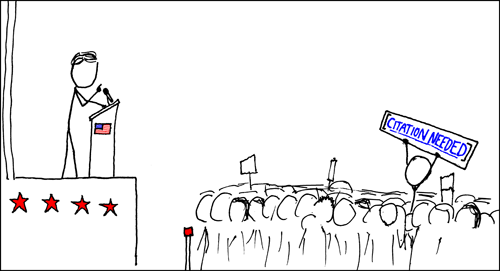
The problem is that in a serial context such as this blog, intellectualization has only two likely outcomes. The first, and worst, is that the audience can see through the ploy, in which case the author is irreversibly discredited in their eyes. The audience members now view themselves as equals, but because the author never extended that position to them, the audience now also feels a need to protect themselves. 'You tried to make yourself better than me', they think, 'but you're not. I'll prove it.'
Bad position to be in.
The second only slightly better outcome is that ploy will succeed. Surprisingly though, but there's actually little to no value in having your audience members feel like they're beneath you. Of course they're less likely to argue, but they're also less likely to listen because they feel disjointed from you as a person. Arguments that are out of our league are never truly accepted by us, and if they're used in a derisive manner they actually just make us feel bad about ourselves. And remember, there is no way I can force someone to come back to this blog. If it doesn't make you feel better about yourself I'm out of luck.
There are however, two methods left that I will swear by any day as the absolute best ways to build trust: empathy and insight.
Empathy, the ability for you to relate to me and to feel as if I relate to you, is the more powerful of the two concepts. We as humans long for connections, validation, and to validate others. There are two facets to empathy in a blog post. If I confirm your existing ideas and opinions, or at the very least if I'm just willing to admit when I disagree with you that an issue is complicated and you're not stupid, that's me empathizing with you. I acknowledge you as a person and show you a measure of respect. I elevate you.
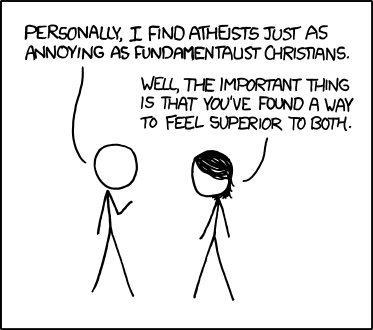
Do you see the difference between self elevation and elevation by others? In self elevation, the burden is on you to maintain your equality with me. You can't truly listen to what I have to say because you're wasting your energy proving to yourself that you're not stupid. If I elevate you I can create a safety net for you and your ideas. I'm not going to call you stupid. I'm not going to make you feel worthless. I'm not going to deride you. Once you trust me not to do that, then you can be more risky with what you consider: in other words it's suddenly OK for you to be wrong. You don't have to spend the energy proving you're as good as me, you can devote all of that energy just to thinking about what I say.
The best thing about empathy is that it's a two way street. If I open myself up to you, admit failings, and honestly share when I'm weak on a topic, your instinct will be to extend the same privileges and respect to me. That provides me with a safety net when I say something stupid, which, over the course of maintaining a blog for ten weeks, I will inevitably do. Rather than turn you away, these failings invite you to extend grace to me. 'I don't agree with him on this topic', you'll say, 'but it's alright, he really does usually know what he's talking about.' Empathy is stinking awesome.
Insight is the glue that holds it together though. I mentioned at the beginning of this article that simply making intelligent statements wouldn't make you trust me. Insight is the loophole. If I can change your mind about one thing, if I can effectively communicate one idea and in the space of this article make you see just one thing differently about the world, I can prove to you that I'm a trustworthy person, or at least worth paying attention to.
Where intelligence relates to complicated factual information, insight relates to the interpretation of that information. If delivered effectively, insight actually integrates me into your worldview; every time you use that particular idea in the real world, you will track it back to me and this blog. And because insight requires the understanding of existing knowledge rather than the taking in of new knowledge, it doesn't unnaturally alienate you as a reader. It makes you feel more confident about yourself rather than less.
If I somehow make you think I'm more intelligent than you, all I've done is make you relate to me less. If I can provide you with insight, I elevate both of us. You trust me more, and you feel smarter. And you feel smarter because of me. That's fantastic; it means that you might come back the next time you want to feel smart again. Understanding something new is extremely addictive.
Of course, arguably now that I've explained all of that to you I'll have nullified its effectiveness, but I don't really think the world or communication works that way. See the best thing about both empathy and insight is they're inherently good concepts, you can use them completely honestly and it doesn't really matter who knows it. Even if you know see what's going on, it's hard to get upset about someone telling you that they value you as a person or that they want to improve your understanding of the world.
Of course, communication is more complicated than this. You can't just pick up one or two buzzwords and expect yourself to be an effective communicator. But, even if flawed, the underlining principle behind all of this is pretty solid and basic: the way you present yourself is just as important as the way you present your information. In order to get people to value your opinion, you need to get them to value you, either for selfish or selfless reasons. That is often more complicated than just making yourself sound smart.

Great thoughts but too many words. Summary: It's all just futile anyway .... well wait, maybe not!?
ReplyDeletePS Keep using the cartoons. Good luck.
Your communication skills are inimitable. Oh, and I truly value both your opinion and YOU.
ReplyDelete