Here's an interesting article to read if you've been playing any video games lately.
I'm a game design major, and most of my views from communication have been developed alongside my views on game design. But having said that, any discussion on Braid for me is a little bit dangerous. It's certainly not a perfect game at least as far as art goes, although it certainly tries to be one, and Johnathon Blow, it's author, is also not a perfect game designer, although he certainly tries hard enough for that as well.
So let me preface all of this by saying that I'm not familiar enough with Braid to offer any view up on whether or not it's a good game. To be painfully honest, I've never actually finished it. Even if I had though, Braid is complicated enough that no matter how familiar I was with it I'd be pretty hesitant to write a blog post deconstructing it.
But lets ignore that and every single tangled-up mess of opinions that it encompasses. Instead, I just want to use Braid as a springboard to talk about whether or not author intent matters in a text, and because I compulsively objectify everything I explore, I want to come as close to possible to drawing an actual conclusion on that.
To communicate, you must convey some type of information. There must be something that is understood by the listener. Always. That's the reason that "art is incomprehensible" views often sound so out of touch with reality. We know that it mattes whether or not we can get something out of art, and we know that there needs to be some type of statement being made, otherwise we wouldn't share any of it.
Interpretation isn't the only part of communication though. You also have the source of the communication, and that interaction leads to some really interesting situations.
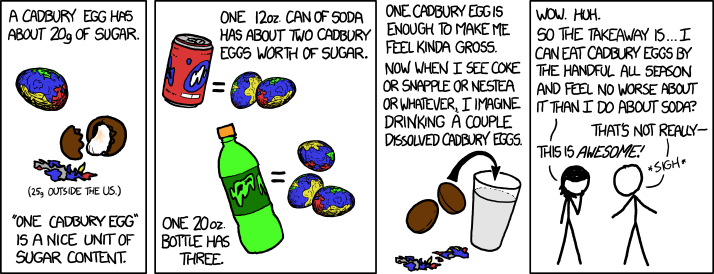
How should we respond when what's communicated and what's understood are two different things?
There are a couple of different views you can take on this. You may say, "Art is subjective. And even if it's not subjective, ideas exist independently of their sources and context." In the comic above, neither interpretation is factually inaccurate, so you'd be forgiven for saying that there is not 'correct' conclusion to draw.
Of course, you could also claim that communication in general has failed in the above comic. What was actually meant to be given wasn't a lot of factual information about cadbury eggs; it was meant to be a viewpoint that explained why soda is gross. So logistically, the author has failed.
We still haven't decided on whether or not variable interpretations are bad for communication though. In fact, we're farther off; if the author has failed to get across his point and the listener doesn't care, how do we conclude whether or not this is 'good' communication?
One thing that may be helpful is to think of all mediums as ultimately means to an end. We don't write, or paint, or talk because these are inherently noble actions; there's always an alternative motive we're working towards. So when you ask whether or not communication is 'good', you have to specify who you're talking about.
Because we're talking about motivation, which will vary infinitely from person to person, there are a lot of different answers to that question.

Is your purpose as an author to communicate an idea? Then personal interpretations are a case of you doing something wrong. Is your purpose to bond with another person? Then empathy, understanding, and connection are more important than actually changing that person's worldview. Before you start talking, understand why and what you actually want to say.
The same holds true from a listener's perspective. Why do you consume media? Why do you listen to other people? Keep in mind that in some cases you may be using communication purely for selfish reasons. If a piece of art makes you feel good, why should you care about whether or not the author intended it to do so?
If there's one point I want to get across in this post, it's that labels may be useful but they aren't sacred. They exist to be used, manipulated, and built upon. Don't talk about what makes good art or bad art. Don't talk about 'correct' communication. Identify what you want, and figure out how to make the tools available move you closer to that goal.
There's a lot more that could be clarified about that, and the last thing I want to leave you thinking is that I'm advocating a completely relativistic view of communication. But... it's a complicated topic so I'll leave it for now.
By the way if you're interested in Johnathon Blow, check out some of his views, a much longer collection of his views, and some (arguably accurate or inaccurate) views others have of him.

"So when you ask whether or not communication is 'good', you have to specify who you're talking about." or to "whom" you are talking. If it is your mom, whose purpose is to bond with you, "Then empathy, understanding, and connection are more important than actually changing that person's worldview."
ReplyDelete